Radcot to Newbridge - a beautiful walk along The Thames Path in England.

Following The Thames Path walking through quite remote countryside passing Radcot Lock, Rushey Lock, Tadpole Bridge and Shifford Lock on the way.
There is a considerable amount of open grass areas around Radcot Old Bridge and bordering the River Thames - however on our last visit to the area much of it was cordoned off into sections with lots of signs which included the word "private". Also the fairly large gravel car park beside the bridge has a sign banning anyone other than pub users from parking in it although on our map it's shown as a Public car park. Anyway they do not apparently hold the right to charge anyone using the Thames Path so the next stage from Radcot Bridge towards Newbridge is an enjoyable wander alongside the River Thames which takes yet another large bend as it passes through open countryside and water meadows to reach Radcot Lock - around 3/4s of a mile away.Another very pleasant tree-lined area and surrounds greets you at Radcot Lock and if it's time to stop and have something to eat then walk on just past the lock (on the path - not the access road) a short distance and there you will find somewhat hidden by shrubs several picnic tables which can be used. Shortly after leaving the lock the Thames Path goes alongside the lock-access road and then leaves it as it reaches Old Man's Bridge (which you do not cross). This wooden bridge (also known as "High Bridge" was re-constructed in 1894 to preserve access and a right of way between several villages and is at the site of Old Man's Weir (also known as Harper's Weir) which was dismantled in 1868.
 From here the path is really out in the countryside with views for miles around and not a building in site - The River Thames really goes for some more serious meanderings and the whole area is beautiful. It might be worth noting two things in particular - the area is so
open that if there was a strong East or North Winter wind blowing then it can get way below the actual air temperature and secondly there are many cattle grazing all of which seem intent on decorating the path as much as possible with cow-pats - so something other than flip flops is a good idea!. Eventually the
path goes into a more tree-lined area and shortly arrives at Rushey Lock. The weir - which was something of a rarity as it is controlled by paddles - has been subjected to a major refit which will unfortunately involve having these paddles removed and a modern series of motorized sluice gates installed. According to the lock keeper
parts of the original concrete are protected and so the authorities will place a smaller dummy version of the paddles next to the sluices in an attempt to show how the weir was originally controlled.
From here the path is really out in the countryside with views for miles around and not a building in site - The River Thames really goes for some more serious meanderings and the whole area is beautiful. It might be worth noting two things in particular - the area is so
open that if there was a strong East or North Winter wind blowing then it can get way below the actual air temperature and secondly there are many cattle grazing all of which seem intent on decorating the path as much as possible with cow-pats - so something other than flip flops is a good idea!. Eventually the
path goes into a more tree-lined area and shortly arrives at Rushey Lock. The weir - which was something of a rarity as it is controlled by paddles - has been subjected to a major refit which will unfortunately involve having these paddles removed and a modern series of motorized sluice gates installed. According to the lock keeper
parts of the original concrete are protected and so the authorities will place a smaller dummy version of the paddles next to the sluices in an attempt to show how the weir was originally controlled.This weir is only a small affair compared with many on The Thames and it would seem that another slice of our history is being removed quite unnecessarily. Now the virtually the ONLY remaining Paddle and Rymer controlled weir on the River Thames is at Northmoor Lock and Weir - and the appalling Environmental Agency want to destroy this too - obviously this agency of the Government have NO INTEREST in Thames history and heritage.

 From the lock the Thames Path switches sides and continues along a narrow lock-access road to reach Tadpole Bridge - there is a limited amount of parking on a lay bye just by the bridge for perhaps 7 cars and also a quite large public
house just across the bridge. Initially from Tadpole Bridge the path goes along between high undergrowth but this soon comes out into a very open area and the path is easy to walk along as it follows The Thames in a huge anti-clockwise bend.
From the lock the Thames Path switches sides and continues along a narrow lock-access road to reach Tadpole Bridge - there is a limited amount of parking on a lay bye just by the bridge for perhaps 7 cars and also a quite large public
house just across the bridge. Initially from Tadpole Bridge the path goes along between high undergrowth but this soon comes out into a very open area and the path is easy to walk along as it follows The Thames in a huge anti-clockwise bend.
 Enjoy
the open spaces while you can because at the end of the bend it then enters a really dense and lush undergrowth area and this stays like this for some miles.
There are very high Poplars growing on the far side of the river and screening by these are perhaps why the area is very damp and humid - the foliage is often well over 6 feet high and this can include extremely tall nettles in places as well as plenty of tough brambles. The path is quite narrow and if the weather
has been wet then very muddy in places - and all the time it is bordered by these huge clusters of nettles - possibly wearing shorts is not too good an idea. Another very prominent plant which has really got itself established along
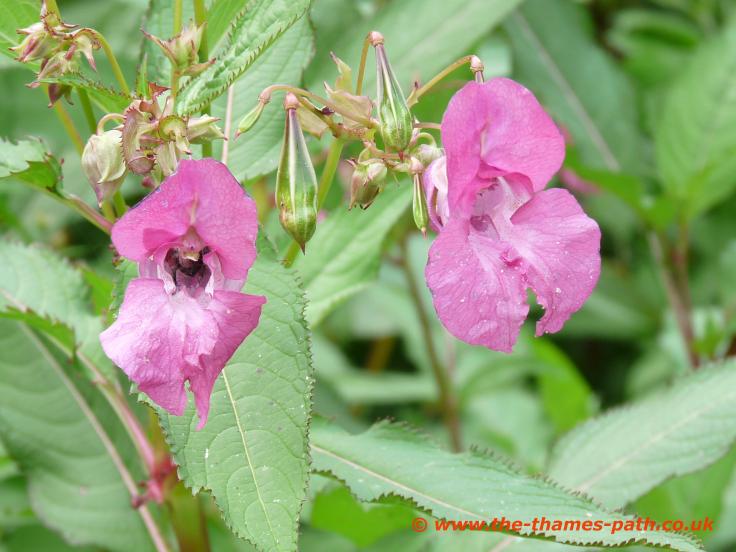
the route are Himalayan Balsam - myriads of pink flowers and in some cases these have even suppressed the nettles. Often as not the adjacent river is not visible and the only reason for knowing it is actually there is because of the sound of
passing boats - this part of the Thames Path is however really excellent for walking through. Eventually the path goes past an old wooden bridge called Tenfoot Bridge which has a little bit of history - it is possible that it is
named after the flash weir once located here and so named because the weir had ten paddles however the weir was dismantled in 1870 and to re-instate the right of way a footbridge was installed.
Enjoy
the open spaces while you can because at the end of the bend it then enters a really dense and lush undergrowth area and this stays like this for some miles.
There are very high Poplars growing on the far side of the river and screening by these are perhaps why the area is very damp and humid - the foliage is often well over 6 feet high and this can include extremely tall nettles in places as well as plenty of tough brambles. The path is quite narrow and if the weather
has been wet then very muddy in places - and all the time it is bordered by these huge clusters of nettles - possibly wearing shorts is not too good an idea. Another very prominent plant which has really got itself established along
the route are Himalayan Balsam - myriads of pink flowers and in some cases these have even suppressed the nettles. Often as not the adjacent river is not visible and the only reason for knowing it is actually there is because of the sound of
passing boats - this part of the Thames Path is however really excellent for walking through. Eventually the path goes past an old wooden bridge called Tenfoot Bridge which has a little bit of history - it is possible that it is
named after the flash weir once located here and so named because the weir had ten paddles however the weir was dismantled in 1870 and to re-instate the right of way a footbridge was installed.
 The
path then goes into open ground, winds past two WWII bunkers and then when you can see lots of trees ahead this means Shifford Lock is nearbye. On the opposite side of the river there is a weir controlling water flow into where the River Thames
itself now wanders away from the Thames Path - this is the start of Shifford Cut and the path follows the Cut rather than the river. At another wooden bridge the Thames Path crosses the Cut and goes sharp left between beautiful trees to reach Shifford Weir and Lock.
The
path then goes into open ground, winds past two WWII bunkers and then when you can see lots of trees ahead this means Shifford Lock is nearbye. On the opposite side of the river there is a weir controlling water flow into where the River Thames
itself now wanders away from the Thames Path - this is the start of Shifford Cut and the path follows the Cut rather than the river. At another wooden bridge the Thames Path crosses the Cut and goes sharp left between beautiful trees to reach Shifford Weir and Lock.
However before going to the lock it may be of interest that having crossed that bridge if you go straight ahead along the bridleway for about half a mile you will arrive at Duxford Ford which provides an ancient way of crossing the River Thames. If there has been much wet weather
or if you can see that the river is fast flowing it's quite possible that the ford is far too deep to actually cross. However this is a beautiful area lined with excellent trees including some huge willows - it's also a quite
popular area for swimming judging from the number of people we saw doing just that when we were there. (Bear in mind swimming in rivers anytime is or can be quite a hazardous activity!).
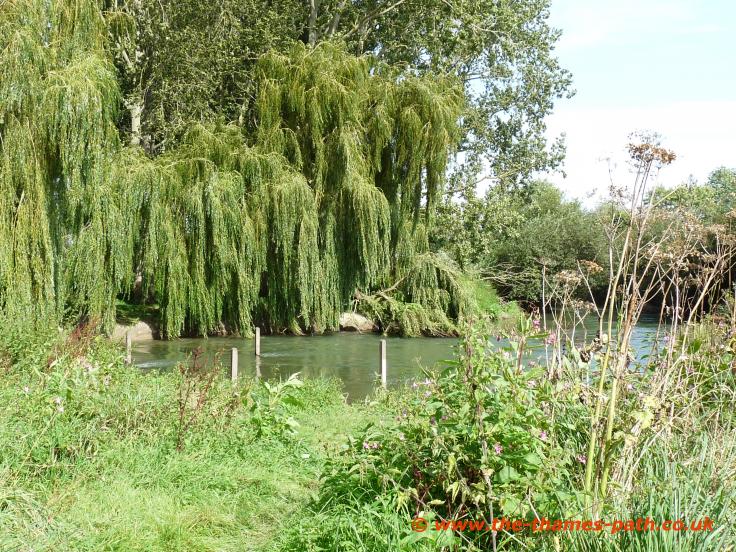
 Continuing along The Thames Path the lock's small weir is reached - the Thames Path continues past the weir however if you wish to see the lock, which in 1898 was the last to be constructed on the River Thames, then you have to divert across said weir.
Shifford Lock is totally surrounded by some very nice trees and the gardens around the lock are quite extensive with plenty of grass areas to sit around on. However at the time of our visit their were no picnic benches and only one small seat - quite unusual for the locks in the area. Also although there is a narrow road
to the lock there is no room at all for public parking - we understand the nearest available is around one mile back up the road at a Nature Reserve.
 Continuing along from Shifford Lock Weir a footbridge crosses the River Thames at the end of the Cut - turn left and from here the Thames Path does not change sides
anymore on it's route to Newbridge. The River Thames certainly (once again) gets back into wriggle mode as it passes through quite open countryside and follows round field edges. If you look through the foliage on the far side of the river you can get several views of the very pretty little church of St. Mary which is sat on
it's own in a field at Old Shifford. Eventually as the River Thames nears
Newbridge it takes a near 45 degree left bend. Also turning sharp left the Thames Path goes over a footbridge and enters a wooded area with the route staying more or less level with the river. This is a really nice walking path but due to the high sloping bank on the right the path can be very muddy during wet weather in places. The wooded area lasts for around a quarter of a mile before
the path once again emerges into the open and is bordered by field edge. By now the path and river are very close to Newbridge and with the beautiful old bridge looking a picture ahead of you both the River Thames and it's Path travel towards it in a fairly straight
direction.
Continuing along from Shifford Lock Weir a footbridge crosses the River Thames at the end of the Cut - turn left and from here the Thames Path does not change sides
anymore on it's route to Newbridge. The River Thames certainly (once again) gets back into wriggle mode as it passes through quite open countryside and follows round field edges. If you look through the foliage on the far side of the river you can get several views of the very pretty little church of St. Mary which is sat on
it's own in a field at Old Shifford. Eventually as the River Thames nears
Newbridge it takes a near 45 degree left bend. Also turning sharp left the Thames Path goes over a footbridge and enters a wooded area with the route staying more or less level with the river. This is a really nice walking path but due to the high sloping bank on the right the path can be very muddy during wet weather in places. The wooded area lasts for around a quarter of a mile before
the path once again emerges into the open and is bordered by field edge. By now the path and river are very close to Newbridge and with the beautiful old bridge looking a picture ahead of you both the River Thames and it's Path travel towards it in a fairly straight
direction.
The Thames Path comes out by the Maybush Public House next to it's car park - if you go right into the car park you can see another section of arches belonging to Newbridge. As a matter of interest the beautifully named River Windrush joins the River Thames just by Newbridge's mediaeval Bridge on the far bank of the Thames opposite the Rose Revived. Continuing towards Oxford involves crossing the bridge and immediately crossing the road to the Rose Revived Public House - the Thames Path goes alongside the river and through the pub's outside eating area.
You may be interested in our Thames Path Lechlade Walk which precedes the above
section or the next part following on from Newbridge which follows the Path - Along The Thames Path walking into Oxford.